How to Start Investing in ETFs
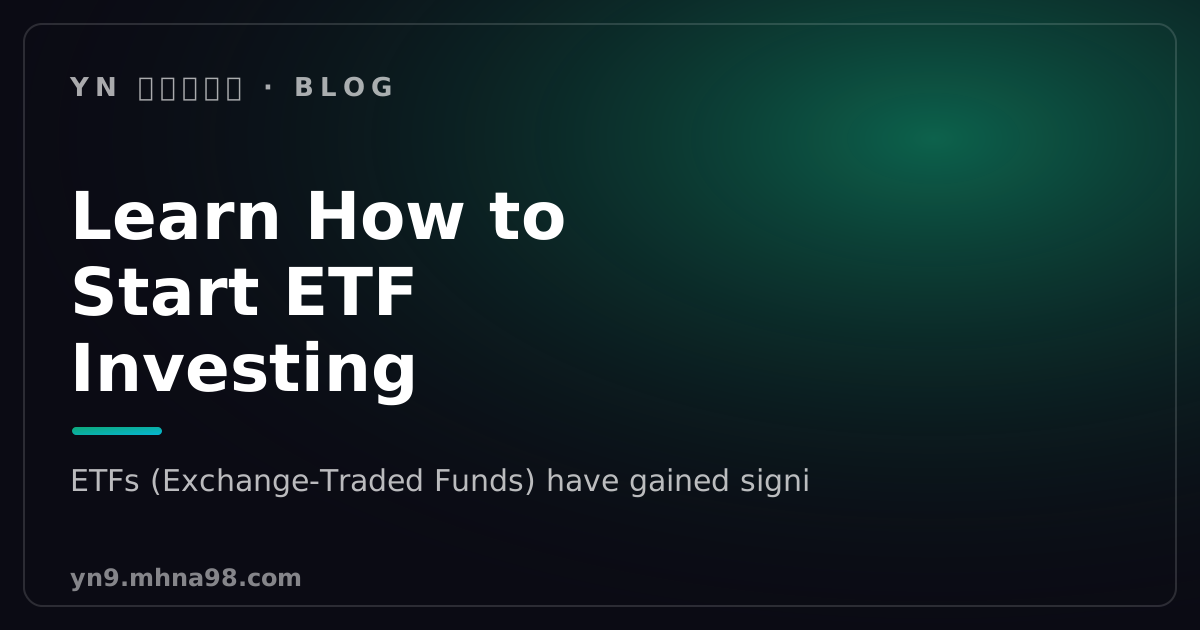
ETFs (Exchange Traded Funds) are investment products listed on the stock market that offer the advantage of diversified investment across various assets. As many investors show interest in ETFs, it is important to understand how to start investing in them.
ETFs are a great way to invest in a variety of assets with a small amount of money.
What is an ETF?
ETF stands for Exchange Traded Fund, which refers to an investment fund that is traded on an exchange like a stock. ETFs can include various assets such as stocks, bonds, and commodities, providing investors with the opportunity to diversify their investments rather than concentrating on a single asset. Additionally, ETFs typically offer low management fees and high liquidity, allowing investors to trade easily in the market.
'%20opacity%3D'0.5'%2F%3E%3Ccircle%20cx%3D'140'%20cy%3D'260'%20r%3D'90'%20fill%3D'%23FFB300'%20opacity%3D'0.25'%2F%3E%3Crect%20x%3D'60'%20y%3D'130'%20width%3D'300'%20height%3D'16'%20rx%3D'8'%20fill%3D'url(%23g1)'%2F%3E%3Crect%20x%3D'60'%20y%3D'166'%20width%3D'210'%20height%3D'12'%20rx%3D'6'%20fill%3D'%23FF6A00'%20opacity%3D'0.4'%2F%3E%3C%2Fsvg%3E)
Advantages of ETFs
First, ETFs provide the benefit of diversification. Investing in a variety of assets reduces risk compared to investing in a single stock. Second, they can be easily bought and sold on the exchange, offering high liquidity. Third, low fees are an advantage. Compared to traditional mutual funds, management fees are lower, allowing for potentially greater returns in long-term investments.
How to Start Investing in ETFs
To start investing in ETFs, you first need to open a brokerage account. Most brokerage firms support ETF trading, so you can choose your preferred broker and open an account. After that, you can select your desired ETF and invest through a buy order. At this point, it is important to thoroughly analyze the underlying assets, management style, fees, and other relevant factors of the ETF you wish to invest in.
'%20opacity%3D'0.5'%2F%3E%3Ccircle%20cx%3D'140'%20cy%3D'260'%20r%3D'90'%20fill%3D'%230EA5E9'%20opacity%3D'0.25'%2F%3E%3Crect%20x%3D'60'%20y%3D'130'%20width%3D'300'%20height%3D'16'%20rx%3D'8'%20fill%3D'url(%23g3)'%2F%3E%3Crect%20x%3D'60'%20y%3D'166'%20width%3D'210'%20height%3D'12'%20rx%3D'6'%20fill%3D'%232563EB'%20opacity%3D'0.4'%2F%3E%3C%2Fsvg%3E)
Criteria for Selecting ETFs
When selecting an ETF, there are several criteria to consider. First, you need to understand the types and characteristics of the underlying assets. There are various types such as equity, bond, and commodity ETFs, so you should find an ETF that matches your investment profile. Second, check the management and transaction fees. Low fees can significantly impact long-term investments. Finally, it's necessary to analyze the ETF's past performance and tracking error to assess its stability.
ETF Investment Strategies
Effective ETF investment strategies include asset allocation strategies and regular investment strategies. The asset allocation strategy involves diversifying across different asset classes to reduce risk. The regular investment strategy involves investing a fixed amount every month, which lessens the impact of market volatility and can lower the average purchase price. These strategies can help pursue stable returns in the long run.
'%20opacity%3D'0.5'%2F%3E%3Ccircle%20cx%3D'140'%20cy%3D'260'%20r%3D'90'%20fill%3D'%230EA5E9'%20opacity%3D'0.25'%2F%3E%3Crect%20x%3D'60'%20y%3D'130'%20width%3D'300'%20height%3D'16'%20rx%3D'8'%20fill%3D'url(%23g5)'%2F%3E%3Crect%20x%3D'60'%20y%3D'166'%20width%3D'210'%20height%3D'12'%20rx%3D'6'%20fill%3D'%232563EB'%20opacity%3D'0.4'%2F%3E%3C%2Fsvg%3E)
Precautions When Investing in ETFs
There are several precautions to keep in mind when investing in ETFs. First, always be mindful of market volatility. Since ETFs are traded like stocks, there can be significant price fluctuations depending on market conditions. Second, leverage ETFs and inverse ETFs are high-risk products and require caution. Finally, it is essential to approach with long-term investment goals and not to be swayed by short-term market fluctuations.
| Item | Recommended Method | General Method |
|---|---|---|
| Criteria | Diversified Investment | Single Asset Investment |
| Fees | Low | Relatively High |
| Liquidity | High | Low |
| Investment Period | Long-Term Investment | Short-Term Investment |
| Risk | Risk Diversification | Risk Concentration |
Before investing, it is crucial to conduct thorough research and develop your own investment plan. Additionally, it's important to pay attention to market changes and respond flexibly.
- Opening a brokerage account
- Selecting the ETF to invest in
- Analyzing the underlying assets
- Comparing fees
- Establishing a long-term investment plan
Investing in ETFs is a great way to diversify across various assets. It requires thorough research and strategic planning, while keeping in mind market volatility. Approaching with long-term investment goals is essential.
FAQ
What is the difference between ETFs and mutual funds?
ETFs can be traded in real-time on exchanges like stocks, while mutual funds can only be traded once a day at a set price.
What is the minimum amount needed to invest in ETFs?
Since ETFs are traded like stocks, the minimum investment amount is determined by the price of one share. Some ETFs can be started with a small amount.
What are the risks associated with ETFs?
ETFs can be exposed to market risk, tracking errors, and liquidity risks, and leveraged ETFs can exhibit significant volatility.